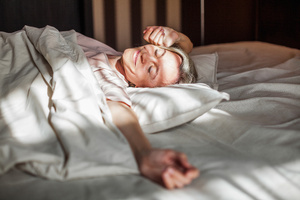

Why Can't I Sleep? Perimenopause Insomnia, Explained
If you're suddenly wide awake at 2 or 3 a.m. most nights, you're describing one of the most common, least...

If you're suddenly wide awake at 2 or 3 a.m. most nights, you're describing one of the most common, least talked-about symptoms of the menopause transition. It's not bad luck, and it's not "just stress." There's a name for it, a clear physiological reason it's happening, and a real answer for what to do about it.
Is this actually insomnia, or just a rough patch? There's a clinical line between going through a short period of poor sleep and “the real thing” (insomnia), and where you land changes what helps.
How long does menopause insomnia last? Longer than most people expect, but it doesn't stay this bad forever.
Is it the hormones, or something else? Mostly hormones. And one of them gets almost no credit for the damage it does.
Will this go away on its own? It tapers. It doesn't reliably disappear.
What actually helps? A short list of things with real evidence behind them... not eight different supplements.
When should I talk to someone? Sooner than "when it gets unbearable."
Read on for the full picture: what's happening hormonally, how long it typically lasts, and what actually makes a difference.
Everyone has bad nights. A stressful week, too much coffee after 2 p.m., a hotel bed. None of that is insomnia, it's just a rough sleep patch.
Clinically, insomnia means trouble falling asleep or staying asleep at least three nights a week, for three months or longer, with a real daytime cost: the fog, the short fuse, the way you reread the same paragraph four times at work. That's the line between "it’s been a rough week" and "this is a clinical problem."
The distinction matters because the two have different starting points. Acute, situational sleeplessness usually resolves when the stressor does. The chronic version that shows up in perimenopause has a biological driver underneath it, with sleep disorder prevalence climbing from roughly 16-42% before perimenopause to 35-60% after menopause, which means waiting it out isn't really a strategy.
Here's something that trips a lot of people up: they assume insomnia means lying awake trying to fall asleep. In perimenopause, that's usually not the main event.
The far more common pattern is sleep-maintenance insomnia. Usually you fall asleep without much trouble, then wake somewhere in the 2-to-4 a.m. window and can't get back down. Research from the Study of Women's Health Across the Nation (SWAN) found that waking up several times a night shows the strongest association with the menopause stage of any sleep complaint tracked. You're not awake because you can't sleep in general. You're awake because something interrupted you, and your nervous system decided 3 a.m. was an excellent time to be alert.
That distinction is useful, because it points straight at why this is happening.
Estrogen gets most of the press here, and it's earned it: estrogen plays a real role in regulating body temperature and sleep architecture, which is part of why hot flashes and night sweats jolt people awake.
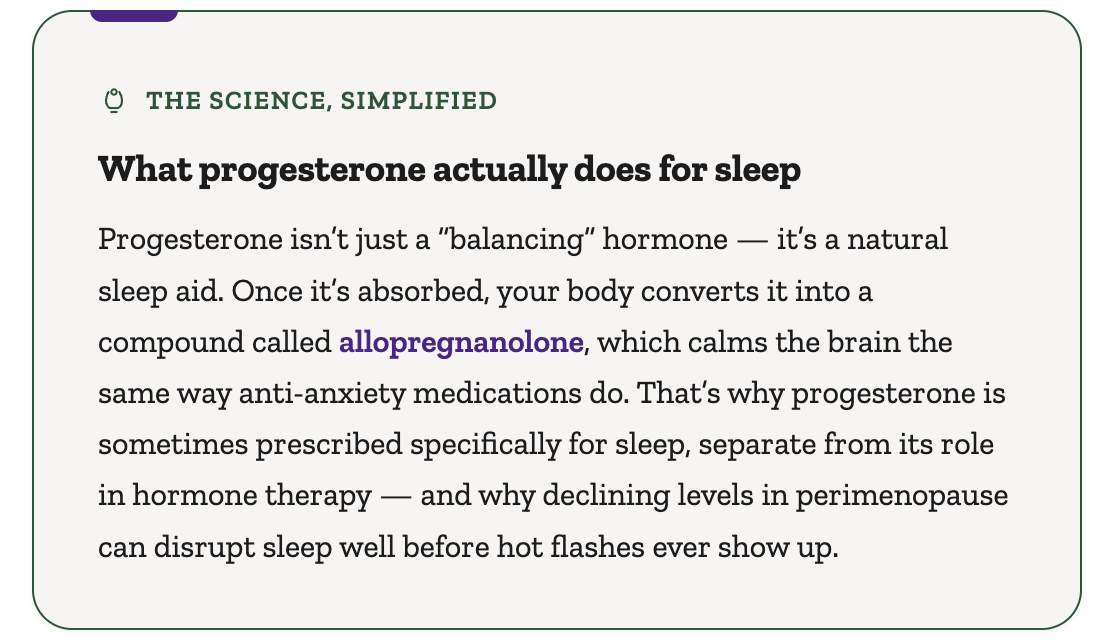
But progesterone deserves its own paragraph, and most doctors skip straight past it. Progesterone breaks down into a brain chemical called allopregnanolone, and allopregnanolone is a positive modulator of the GABA-A receptor — the same receptor targeted by benzodiazepine sedatives which are commonly prescribed for insomnia. It's a natural sedative your body has been making for decades without you ever noticing.
Here's the part that explains a lot of confused, sleepless 43-year-olds: progesterone often declines before estrogen in perimenopause, since it depends on regular ovulation, which becomes less frequent years before estrogen production meaningfully drops. That means sleep can fall apart before hot flashes ever show up. If you've been told "you're too young for menopause symptoms" while lying awake at 3 a.m., this is very likely why nobody believed you, including possibly yourself.
Even once you're past the hormonal mechanics, perimenopause stacks the deck with its own list of physical interruptions. A 2024 narrative review found that night sweats, nocturia, restless legs syndrome, and periodic limb movements all increase as women move through the menopausal transition, and a population study of Swedish women found a strong association specifically between night sweats and restless legs syndrome. Any one of these can break a sleep cycle. Several together can make a full night of sleep feel like a rare event.
Most articles treat anxiety and mood as a footnote to the "real" causes. It deserves its own section, because the relationship runs both directions. As progesterone drops, so does the brain's natural calming signal. This is why many women first notice new or worsening anxiety during perimenopause, even when nothing in their life has changed. The 2 a.m. email replay isn't a coincidence, it's a known pattern. And a systematic review of postmenopausal women confirmed that sleep and mood symptoms move together in a bidirectional loop: poor sleep worsens anxiety and depression, and anxiety and depression in turn worsen sleep. It's a loop, not a one-way street, and untangling it usually means addressing both rather than treating the racing thoughts as a separate problem from the hormones.
This is the question almost nobody answers directly, so here's a direct answer: longer than a "phase," shorter than forever.
Longitudinal data from SWAN shows sleep disturbance is most pronounced during early perimenopause and remains elevated relative to the premenopausal baseline. Importantly, modeling of SWAN participants found that most women don't follow a uniformly worsening path. The majority fall into "low" or "moderate" sleep-disruption trajectories.
For some women, sleep does genuinely improve once they're a couple of years past their final period. For others, the disruption tapers but doesn't fully go away, especially if other contributors (chronic pain, untreated anxiety, sleep apnea that went undiagnosed for years) are still in the mix. The same SWAN trajectory research found that pre-menopause sleep patterns were predictive of post-menopause sleep patterns, meaning sleep problems don't reliably resolve on their own once they're established. The honest version is: hormonal sleep disruption alone tends to ease over time, but it's not a guarantee, and "wait it out" isn't a good plan for most women.
When sleep trouble is tightly linked to night sweats, hormone therapy is often the first option worth discussing with a clinician. Addressing the hot flashes directly removes the interruption causing the wake-ups.
There's a more targeted version of this too: progesterone is sometimes prescribed specifically for sleep, separate from its role balancing estrogen in combination therapy. A review of clinical trials found that oral micronized progesterone taken at night helped people fall asleep faster, with some studies also showing more total sleep and fewer middle-of-the-night wake-ups. It makes sense given what's covered above — it's working through that same calming brain pathway, so the cause and the treatment are directly connected here, not just loosely related.
CBT-I is the most evidence-backed non-hormonal treatment for chronic insomnia. It works by retraining the thoughts and habits that keep insomnia going once it's started (including the anxiety-about-not-sleeping that makes everything worse). A randomized controlled trial from the MsFLASH research network found that telephone-delivered CBT-I produced significant improvements in insomnia symptoms, sleep quality, sleep latency, and sleep efficiency in midlife women with hot flashes, with benefits still present 24 weeks later. It's typically delivered over a handful of sessions with a trained provider, and many people see meaningful improvement within weeks.
The basics still matter here, even if they're not glamorous: a consistent sleep and wake time (even on weekends), a cool bedroom, and cutting off alcohol and caffeine earlier than 5 pm. Daytime exercise is also a great idea as it’s consistently been associated with improved sleep quality. These won't fix a hormonal sleep disruption on their own, but they remove added obstacles standing between you and whatever else is working.
Estrogen helps your body absorb and hold onto magnesium. As estrogen declines, your body becomes less efficient at retaining it, even if your diet hasn't changed. That matters for sleep because magnesium plays a key role in calming the nervous system. It helps regulate melatonin (the hormone that tells your body it's time to sleep) and supports the same relaxation pathways disrupted by hormonal changes.
The research is genuinely promising, though not a slam dunk. A 2025 randomized controlled trial found that people taking magnesium bisglycinate daily fell asleep faster and had lower insomnia scores than those taking a placebo, with the biggest gains in people who were already running low on magnesium to begin with. What that means in practical terms: magnesium is unlikely to fix a serious hormonal sleep disruption on its own, but it may take the edge off, especially if your levels have slipped without you realizing it.
If you want to try it, magnesium glycinate (sometimes called bisglycinate) is the form most commonly used in sleep research and is generally gentler on the stomach than other forms. Taking it in the evening, about an hour before bed, is the most common approach. As always, if you're on other medications or have kidney issues, check with a clinician first.
There's a quiet assumption a lot of us carry into our 40s and 50s: that you tough out sleep problems until they're bad enough to "earn" a doctor's appointment. That's backwards. Talking to someone sooner than later is the fastest route to actually sleeping again. Sleep is a key foundation to overall health and wellbeing, including mental health, as discussed above. Waiting to see if symptoms resolve themselves often leads to larger problems.
A clinician who actually understands the menopause transition can sort out whether what's keeping you up is hormonal, situational, or something else entirely (sleep apnea and thyroid issues both like to disguise themselves as "just menopause"). That's the kind of nuanced, individualized help that is sometimes hard to get from your primary care provider, because insomnia during the menopause transition often requires a more individualized evaluation than simply prescribing a sleep medication. If you're ready to stop guessing, you can talk to an Inflexxion Health clinician and get a plan that's actually built around what's happening in your body.
Is perimenopause insomnia the same as regular insomnia? They overlap clinically — both involve trouble falling or staying asleep — but the triggers are different. Regular insomnia is often tied to stress, habits, or circumstance. Perimenopausal insomnia has a hormonal driver underneath it, which is why it can show up even when nothing else in your life has changed.
Can perimenopause insomnia happen even without hot flashes? Yes. This is exactly where progesterone's early decline comes in. Since progesterone often drops before estrogen does (Santoro et al., 2021), sleep can suffer years before hot flashes or night sweats ever appear.
What's the fastest thing that helps when I can't fall back asleep? Get out of bed rather than lying there willing it to happen. Keep the lights low, do something boring and non-screen-based for 15-20 minutes, then go back when you actually feel sleepy. This isn't a substitute for treating the underlying cause, but it stops a 20-minute wake-up from turning into a two-hour one.
Does menopause insomnia get better after menopause? Often, yes. It tends to taper as hormone levels stabilize postmenopause for most women, though a meaningful minority experience a sustained rise in insomnia instead. But "taper" isn't the same as "vanish," especially if other factors are contributing, so it's worth treating rather than just waiting on.
Can supplements like melatonin or magnesium really help? They can help some people at the margins. Melatonin may help with falling asleep initially, and there's modest evidence for magnesium and relaxation. Neither is a strong fix for hormonally driven wake-ups in the middle of the night, so think of them as a possible assist, not the main plan.
Is it safe to take sleep medication long-term during perimenopause? Short-term use under a clinician's guidance is generally considered reasonably safe for getting through a rough stretch. Long-term use is a different conversation with different risks, which is exactly why it's worth having that conversation with a clinician rather than refilling the same prescription for years on autopilot.
Bishop, B. M., Lieblich, S., Hoyt, C., & Joffe, H. (2025). Impact of sleep disturbances on health-related quality of life in postmenopausal women: A systematic review. Climacteric. Advance online publication. https://pmc.ncbi.nlm.nih.gov/articles/PMC12727067/
El Khoudary, S. R., Greendale, G., Crawford, S. L., Avis, N. E., Brooks, M. M., Thurston, R. C., Karvonen-Gutierrez, C., Waetjen, L. E., & Matthews, K. (2019). The menopause transition and women's health at midlife: A progress report from the Study of Women's Health Across the Nation (SWAN). Menopause, 26(10), 1213–1227. https://pmc.ncbi.nlm.nih.gov/articles/PMC6784846/
Kravitz, H. M., Kazlauskaite, R., & Joffe, H. (2020). Trajectory analysis of sleep maintenance problems in midlife women before and after surgical menopause: The Study of Women's Health Across the Nation (SWAN). Menopause, 27(7), 749–756. https://pmc.ncbi.nlm.nih.gov/articles/PMC7047569/
McCurry, S. M., Guthrie, K. A., Morin, C. M., Woods, N. F., Landis, C. A., Ensrud, K. E., Larson, J. C., Joffe, H., Cohen, L. S., Hunt, J. R., Newton, K. M., Otte, J. L., Carpenter, J. S., Freeman, E. W., Reed, S. D., Sternfeld, B., Tinker, L. F., & LaCroix, A. Z. (2016). Telephone-based cognitive behavioral therapy for insomnia in perimenopausal and postmenopausal women with vasomotor symptoms: A MsFLASH randomized clinical trial. JAMA Internal Medicine, 176(7), 913–920. https://pmc.ncbi.nlm.nih.gov/articles/PMC4935624/
Nolan, B. J., Liang, B., & Cheung, A. S. (2021). Efficacy of micronized progesterone for sleep: A systematic review and meta-analysis of randomized controlled trial data. The Journal of Clinical Endocrinology & Metabolism, 106(4), e942–e951. https://doi.org/10.1210/clinem/dgaa873
Pengo, M. F., Bonafini, S., & Fava, C. (2024). Sleep disturbance and perimenopause: A narrative review. Diagnostics, 14(6), 583. https://pmc.ncbi.nlm.nih.gov/articles/PMC11901009/
Santoro, N., Roeca, C., Peters, B. A., & Neal-Perry, G. (2021). The menopause transition: Signs, symptoms, and management options. The Journal of Clinical Endocrinology & Metabolism, 106(1), 1–15. https://www.sciencedirect.com/science/article/abs/pii/S037851222100027X
Soni, A., Singh, P., & Bhattacharya, S. (2025). Menopause and mental health. Journal of Family Medicine and Primary Care. https://pmc.ncbi.nlm.nih.gov/articles/PMC12237151/
Wesström, J., Nilsson, S., Sundström-Poromaa, I., & Ulfberg, J. (2008). Restless legs syndrome among women: Prevalence, co-morbidity and possible relationship to menopause. Climacteric, 11(5), 422–428. https://pubmed.ncbi.nlm.nih.gov/18781488/